
Liftek blog post
India's offshore oil and gas sector is going through rapid growth. Recent reforms and new licensing rounds have helped with the exploration. Analysts now forecast over 1,100 new offshore wells by 2030, with about a 20% production boost. Several greenfield projects and deepwater programs are also underway to raise output.
At the same time, India's renewable energy targets are driving new marine projects, with the country planning roughly 30 GW of offshore wind capacity by 2030, a proof of broader expansion of India's marine energy industry. All told, these developments also mean a rise in underwater engineering and support tasks.
Underwater work in the offshore sector faces major challenges. Teams must operate in cold, dark, high-pressure environments, often hundreds or thousands of meters down. It is worth understanding that in most cases, crews must manage the lifting and lowering of loads under seawater, sometimes to depths of up to 3,000m, despite extreme ambient conditions, waves, unpredictable currents, and poor lighting.
Saltwater corrosion and short dive-time windows further complicate operations. Even moving a moderately heavy object is difficult, let alone lifting large structures like pipelines or wreckage, which would require massive cranes, making tasks slow, risky, and expensive.
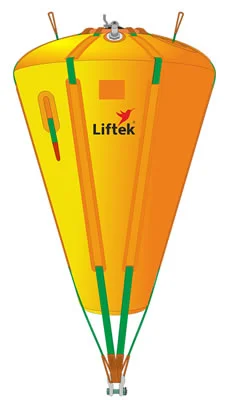
Subsea air lift bags, or underwater air lift bags as they are also known, are a key solution for underwater lifting tasks. These devices are large inflatable buoyancy bags that divers attach to submerged loads. Most bags have a parachute-like shape and a single attachment point for the load.
There are mainly two common designs. One is an open-bottom bag, air is pumped in, and water flows out of the bottom opening, balancing pressure. When fully inflated, the bag provides buoyancy that gently lifts the attached object toward the surface. The other being a sealed pontoon bag, by contrast, holds its air entirely and acts like a solid float and is often useful for shallower lifts.
Underwater air lift bags offer several advantages for marine operations. They are very cost-effective and compact when deflated. Small lift bags of 0.05–0.5 tonne capacity cost only a few hundred dollars each and fold into tight packages, making them an economical lifting solution for many tasks. Even very large bags pack down for easy transport, and a few divers can deploy them without waiting for heavy cranes.
Crews also get fine control over a lift: by slowly venting air, they can prevent sudden jerks, protecting delicate equipment and cargo. Lift bags allow engineers to perform staged lifts, keep ascent speeds low, and gradually raise objects from the seabed. In short, air lift bags reduce the manpower, cost, and risk of heavy lifts compared to mechanical hoisting alone.
Several factors explain why the demand for subsea lift bags is rising in India. Offshore projects of all kinds are multiplying. Industry reports indicate that ONGC plans more than 25 new offshore platforms and over 1,000 km of subsea pipelines in the coming years. India has also begun large-scale decommissioning projects, one of the major ones involving the removal of five wellhead platforms and miles of pipelines.
Even routine maritime incidents add to demand. In 2025, a sunken container ship off Kochi prompted a large underwater salvage effort. In such jobs, air lift bags assist in raising wreckage and cargo safely. As India's offshore oil/gas work, port activities, and even planned wind developments expand, the need for buoyancy and lift solutions grows in parallel.
India's offshore and marine sectors are expanding rapidly, and with that growth comes a need for effective underwater lifting solutions. Subsea air lift bags provide a safe, controllable way to raise heavy items from the seabed, making them indispensable in offshore construction and salvage. Suppliers are responding with high-quality products.
With decades of experience in lifting and rigging solutions, Liftek International supports this growing demand through a specialized range of underwater air lift bags and related equipment. Our parachute-style and fully enclosed subsea airlift bags range from 0.1 to 50 metric tons WLL and are built with top-tier safety factors under IMCA standards.
As India speeds up its offshore development, having access to trusted, field-tested tools is key to making sure operations remain safe, efficient, and on schedule.


Liftek Technical Services LLC
P.O. Box: 8751, Musaffah Industrial Area, M-44,
Abu Dhabi, UAE
Liftek Technical Safety LLC
Office No 803, Suntech Tower, Silicon Oasis,
Dubai, UAE
Copyright © 2026 www.liftek-intl.com. All Rights Reserved.
